

The FAA’s revised guidance for Part 91 LOA B036 introduced a risk assessment worksheet that can determine whether an operator must complete a validation test, commonly referred to as a “tabletop” evaluation. We briefly introduced this change in our earlier article covering FAA Notice N 8900.756.
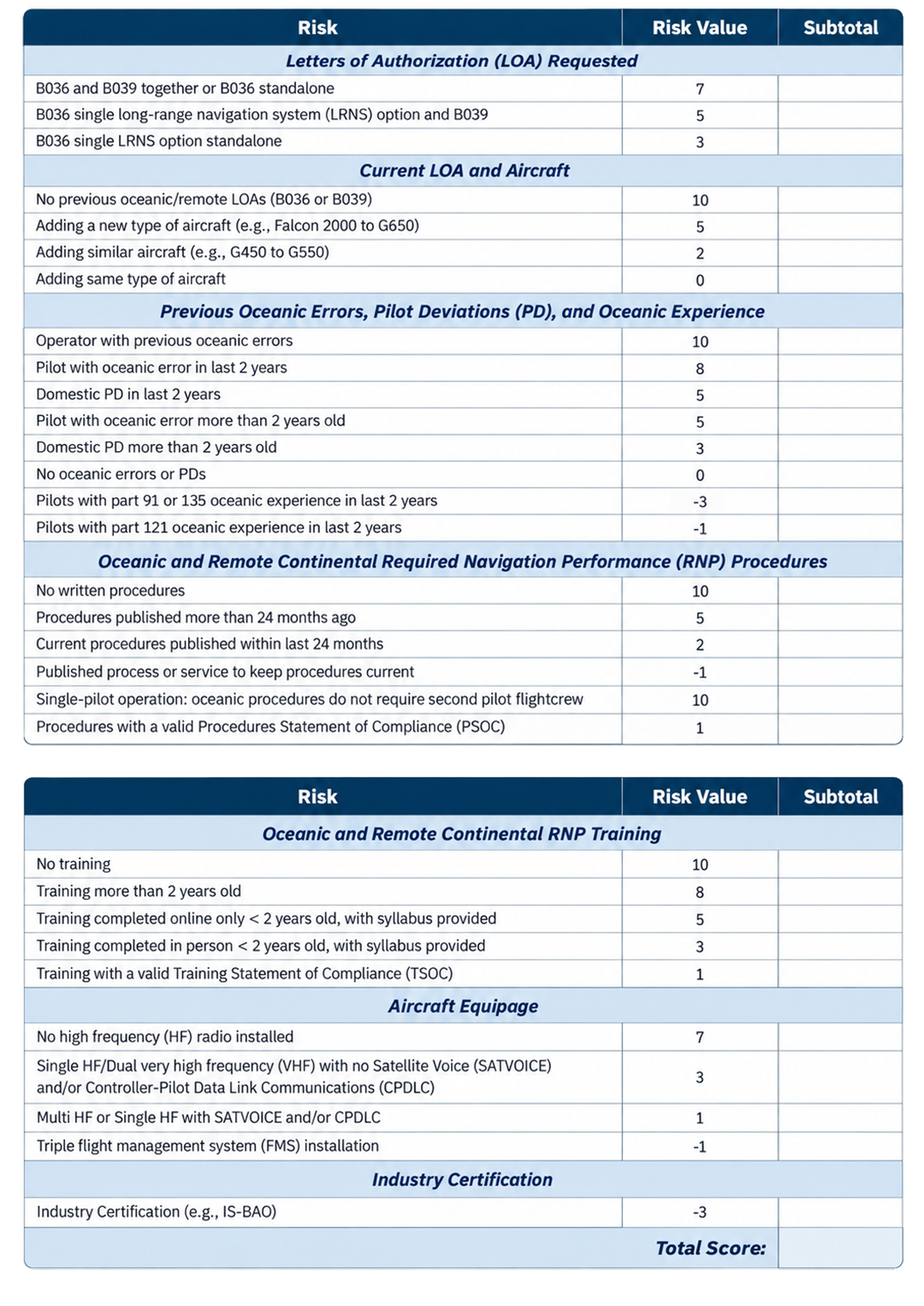
For operators preparing a B036 application, the worksheet makes training, procedures, operational experience, aircraft equipage, and prior operating history part of a defined scoring process. Some applicants will move through the application without validation testing. Others may face additional FAA evaluation based on the resulting risk score.
The FAA developed the worksheet to provide inspectors with a standard, objective method for assessing an operator’s risk and determining whether validation testing is appropriate for a particular B036 applicant.
The final score places the application into one of three ranges:
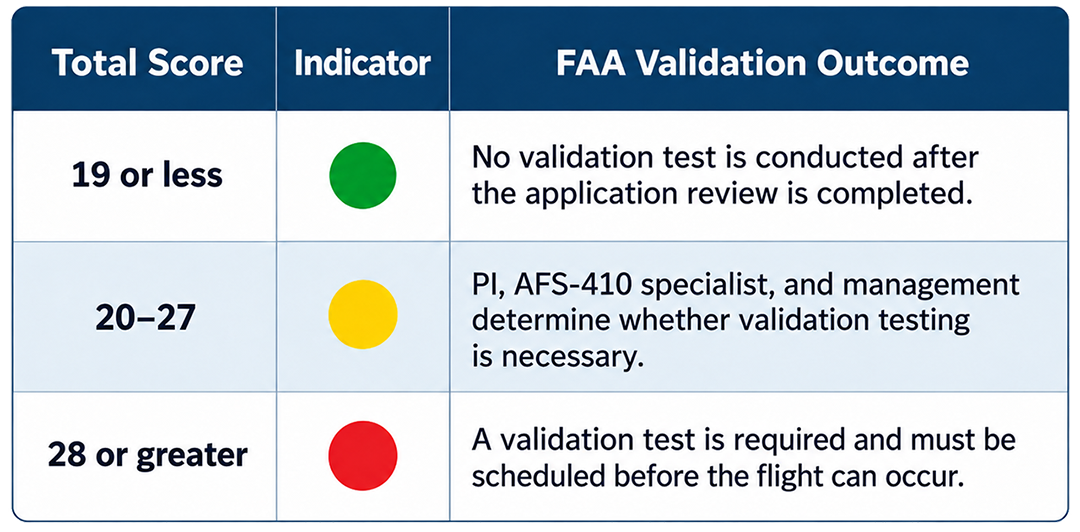
This is an important distinction for operators preparing B036 applications. A lower score can eliminate the tabletop requirement, while a higher score adds another validation step before authorization can be completed.
A tabletop exercise is a moderately high-level test administered by the FAA. Per FAA Advisory Circular 150/5200-31C:
The tabletop exercise is a higher-level test than the drill and is designed to provide training and evaluate plans and procedures and to resolve questions of coordination and assignment of responsibilities in an informal, non-threatening format without concern for time constraints, stress levels, or actual simulations. The methodology of the tabletop exercise is by discussion in a meeting format through a facilitator. Effectiveness is determined by feedback from participants and the impact this feedback has on evaluating and revising policies, plans, and procedures. There is no utilization of equipment or deployment of resources. Therefore, all activities are simulated and participants interact through discussion.
Although the tabletop exercise can be wrapped up in a day, the time it takes to schedule the exercise can vary greatly. It may very well be the case that the FAA cannot get the operation into the office earlier than two months out, which is a massive delay.
The actual tabletop exercise is carried out with an inspector in what is best described as a checkride. All of the documentation intended to be on the aircraft will be present, and the inspector will request that the pilot walk through the process. This may include:
Although the tabletop exercise is fully open book, the instructor will also investigate the manuals and procedures to ensure they’re high quality. If the manuals are inadequate or if the procedures are insufficient, the documents will have to be recreated, causing further delays. It’s thus crucial that operations have the highest quality manuals to prevent these additional issues.
Because possession of a valid PSOC and TSOC would effectively only add two points to an assessment, their acquisition is important. They’ll lower the chances that a tabletop exercise will be necessary and will allow operations to continue as normal. The FAA will be aware that the operation is experienced and well equipped to handle the challenges of oceanic / remote airspace navigation.
Without valid and up-to-date documents, the operation faces tougher scrutiny and potential delays, as outlined above.
Below are the specific Oceanic and Remote Continental RNP Procedures as seen in the B036 assessment.
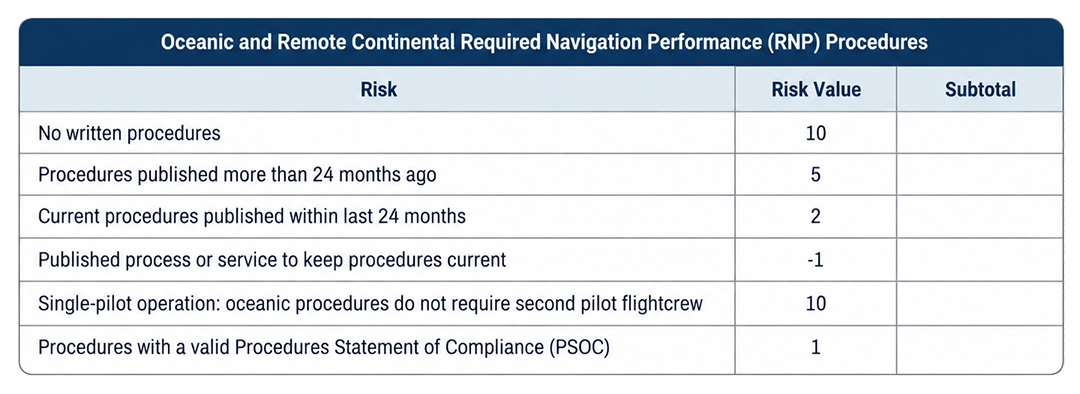
An operation that does not have any written procedures will be hit with the highest score possible. The consequences are less severe for procedures that were published two years ago, and even less so for those published within two years. It’s important to keep procedures current for this reason, and a valid PSOC helps keep the score low.
The PSOC provides evidence that your procedures are up-to-date and comprehensive enough to meet the bare minimum requirements that the FAA imposes.
Below are the specific Oceanic and Remote Continental RNP Training Procedures.
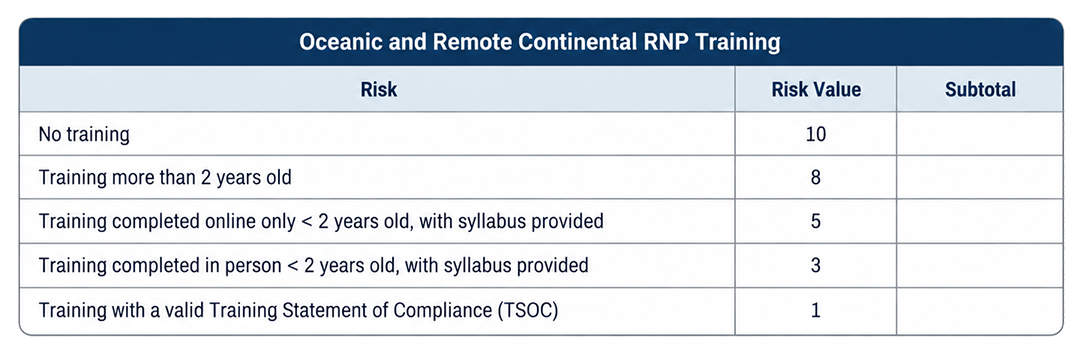
Again, pilots who have no training are hit with the highest score. Outdated training is almost as severe, and online training is only considered half as valid as in-person training. However, a valid TSOC proves that the pilots have been trained properly and within the correct time allowance.
The TSOC provides evidence that your training is up-to-date and encompasses sufficient information and scenarios that you will need to know when you’re crossing oceans.
Sky Safety Solutions is the only company in the country with FAA-approved TSOC and PSOC accreditation. Working with us is working with aviation experts who are familiar with the FAA and its processes – and can ensure you’re in good shape on the risk assessment form. Our goal is to move you smoothly through the form and skip any roadblocks that may hinder your operation. It’s more efficient and cost effective to go through a single organization than to piecemeal the documents together from multiple sources. Additionally, the training you receive is on this specific manual set, with no reference to general manuals, ensuring precise language and direction.
As a one-stop-shop for compliance documents, we’re a valuable asset to your company, and help you through the process from start to finish and beyond.